

Following the Government’s proposed 30% tax on discretionary trust (DT) distributions from 1 July 2028 announced in the 12 May 2026 Federal Budget some have been considering setting up companies with more than one share class. This is based on the thinking that this will provide greater flexibility.
However, there are a number of tax issues that should be considered. This article outlines some of these risks.
Current context
From 1 July 2028, trustees of DTs will generally pay a minimum 30% tax on their taxable income, subject to certain exceptions such as primary production income and income from certain testamentary trusts. The legislative provisions are still to issue following limited consultation.
Individuals and other (non-corporate) beneficiaries will receive non-refundable tax credits for the minimum 30% tax payable by the trustee which will reduce their income tax payable. This is designed to ensure that tax paid on DT income is not less than 30%.
For more information on the proposed changes to the taxation of DTs, refer to our article here.
Prior context – Dividend access shares
Prior to 2014, there was also interest shown in what was then referred to as ‘dividend access shares’ (DAS). Broadly, the ATO considered DAS in TD 2014/1 as shares having the following rights:
- a right to receive a dividend at the discretion of the company’s directors;
- no voting rights or rights to participate in the surplus assets upon a winding up of the company; and
- a right by the company to redeem the shares within 4 years or they ceased to exist.
Based on the facts in TD 2014/1, the ATO considered the arrangement involving a variation to a company’s constitution to insert DAS where a company had accumulated significant profits to distribute dividends to other shareholders was a dividend stripping scheme within the meaning of s 177E, which is part of the general anti-avoidance provisions in Part IVA of the Income Tax Assessment Act 1936 (Cth) (ITAA 1936).
While the facts in TD 2014/1 are quite specific and do not apply to a company established with more than one share class, there are a range of other tax risks outlined below that still should be considered when ordering a company with more than one share class.
A typical type of DAS (but different to the one in TD 2014/1) may appear attractive in minimising legal risk as it is generally issued for $1.00 on registration of the company, has rights to dividends and provides repayment of the issue price but provides no right to share in surplus assets on a winding up of the company.
Some companies therefore issued DAS to achieve income splitting. In the typical scenario of a family company started by parents who, as directors, wanted to distribute money to their children, a DAS typically valued at $1.00 could be issued to the children. This allowed the parents to distribute dividends to children without being too concerned if their children went through a relationship break up, was sued or was poor at managing their own affairs. Thus, a company with DAS broadly provided some flexibility (but less flexibility/discretion than that enjoyed by trustees of DTs).
As noted above, the ATO’s dividend stripping concerns in TD 2014/1 involved a company with significant accumulated profits and the insertion of DAS to allow dividends to be streamed the new DAS shareholders for a $1.00 paid up capital, which would be redeemed within 4 years. This can be contrasted to a company being established with more than one class of share, when the company has no accumulated profits or assets. However, there are various tax integrity rules that still need to be considered.
Tax integrity rules
Navigating the tax integrity, or anti-avoidance, rules where a company has more than one share class and seeks to stream different dividends and/or capital to different shareholders, involves ongoing careful management given the following provisions in the ITAA 1936 or the Income Tax Assessment Act 1997 (Cth) (ITAA 1997), including:
In the ITAA 1936:
- Section 45A of the ITAA 1936– streaming of dividends and capital benefits, which could result in a capital benefit being treated as an unfranked dividend under s 45C of the ITAA 1936.
- Section 45B of the ITAA 1936– providing capital benefits in substitution for dividends, which again could result in a capital benefit being treated as an unfranked dividend under s 45C of the ITAA 1936.
- Section 177E of the ITAA 1936– dividend stripping, which can result in the cancellation of a tax benefit. This was what the ATO applied to the DAS in TD 2014/1.
- Section 177EA of the ITAA 1936– schemes for the disposition of shareholder interests, where a person is expected to receive imputation benefits, which could result in a franking debit or the denial of imputation benefits.
- Part IVA of the ITAA 1936 – the general anti-avoidance rule, which can result in the cancellation of a tax benefit.
- Schedule 2F of the ITAA 1936– family trust elections and interposed entity elections and the potential for family trust distribution tax to be imposed.
In the ITAA 1997:
- Division 152 of the ITAA 1997 – CGT small business concessions especially in calculating an entity’s small business participation percentage under Div 152.
- Division 204 of the ITAA 1997– dividend streaming to those who might derive a greater benefit from franking credits, which could result in a franking debit arising, an exempting debit arising or the denial of imputation benefits.
- Divisions 725 of the ITAA 1997 – direct and value shifting where there is a decrease in value of equity or loan interests.
- Division 727 of the ITAA 1997 – indirect value shifting where there is a shift in value from one entity to another.
- Division 974 of the ITAA 1997 – the debt/equity rules, which can result in the re-characterisation of certain debt as equity and vice versa, for tax purposes.
Naturally, each of these rules contain different elements of complexity and risk. Thus, we recommend expert advice where there is any doubt.
DBA Lawyers’ constitution – share classes
The rights of each class of share under the DBA Lawyers’ constitution is summarised in the table below. Ordinary shares confer rights to dividends, voting, and a distribution of surplus assets upon the winding up of the company. Our constitution also includes several different classes of ordinary shares that can be issued (eg, class AA –Ordinary shares, class BB–Ordinary shares, etc).
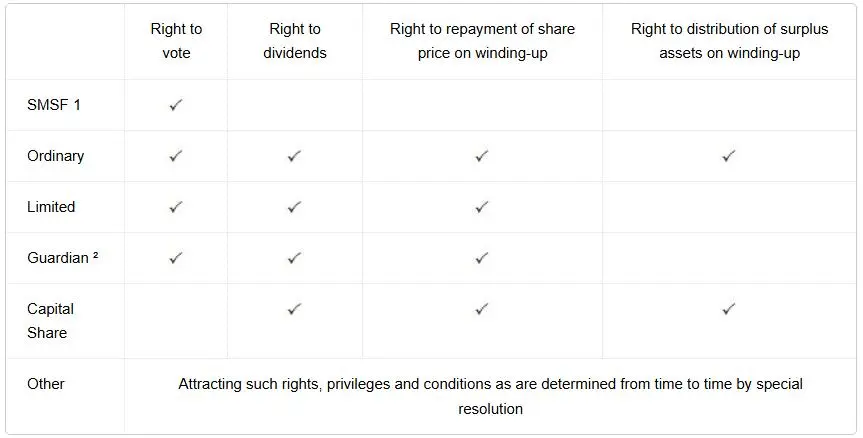
Importantly, the DBA Lawyers’ constitution does not contain a ‘DAS’ class of shares. Instead, our constitution contains a ‘limited’ class, which gives a shareholder the right to dividends, a right to vote and a right to be repaid the issue price on each share upon a winding up.
This choice by DBA Lawyers means that directors can, subject to the rights of each share class, generally declare dividends in respect of different share classes subject to assets exceeding liabilities and the dividend is fair and reasonable. This is not to say, however, that the use of more than one class of share will be without risk. We recommend that those seeking to insert more than one class of share obtain advice in view of their particular facts.
Corporations Law
We have also had a number of recent inquiries where clients with companies with multiple share classes are seeking to simplify their affairs. In particular, the ‘Minimum tax on discretionary trusts, Consultation Paper of 8 July 2026’ suggests that rollover relief from a DT to a company will not apply unless there are fixed and transparent structures. This extract is from page 9 of Treasury’s Consultation Paper:
Relief is also not intended to apply where assets are transferred into a company structure with multiple classes of shares that permit dividends or capital returns to be directed between participants on a discretionary basis. For example, the rollover could be restricted to companies with a single class of ordinary shares (or classes with materially equivalent distribution and capital rights).
For those that need to undertake some changes to their companies prior to the proposed rollover relief that should apply from 1 July 2027, there are various provisions in the Corporations Act 2001 (Cth) that also must be satisfied before cancelling, redeeming or buying back shares where legal advice should be obtained.
Conclusion
Before issuing more than one class of share, we recommend that expert tax advice be obtained due to the various tax integrity rules that might apply.
Also, before seeking to remove a class of share, expert advice should also be obtained to ensure the requirements in the tax law and the Corporations Act 2001 (Cth) are fully complied with.
DBA Lawyers will be monitoring developments as the legislation relating to the tax treatment of trusts and rollover relief issues. Naturally, we would be pleased to assist as needed.
Related articles:
- Proposed changes to the taxation of discretionary trusts from 1 July 2028
- Benefits of a DBA Lawyers’ Company or Constitution Update
- Why is it important to have a good company constitution?
- Family trust elections – one choice, lasting consequences – Part 1
- What to do if a company’s constitution is lost?
* * *
By Daniel Butler, Director ([email protected]), Fraser Stead, Lawyer ([email protected]) and Cassandra Hurley, Lawyer ([email protected]).
Note: DBA Lawyers presents regular SMSF Online Updates. For more details or to register, visit www.dbanetwork.com.au or call 03 9092 9400.
For more information regarding how DBA Lawyers can assist in your SMSF practice, visit
This article is for general information only and should not be relied upon without first seeking advice from an appropriately qualified professional.
DBA LAWYERS
27 August 2026
